
Playing the handpan can be an enriching experience, determined by the right scale to learn, which also defines a player’s ability to be musical. Out of the plethora of choices, the Dorian scale is particularly favored due to its lush and rather modifiable sound that brings about a profound but compelling suspense and nostalgia. This shouldn’t undermine the importance of many other scales that players of the handpan can choose from. Whether you are an established artist or an amateur handpan player, a good grasp of different scales is bound to change the way you play and how you appreciate this irresistible instrument.
This paper will drill down into the Dorian scale as well as other favourite handpan scales that have successfully turned their players and listeners into ardent fans. You will learn the effect of these exotic scales handpan, giving the moods and feelings of the music, enabling you to decide upon the appropriate one for a particular kind of expression that you intend to achieve. This will open the doors of perception of sound in societies where people ignore that kind of music or where it is considered rare handpan tunes.
Understanding Handpan Scales
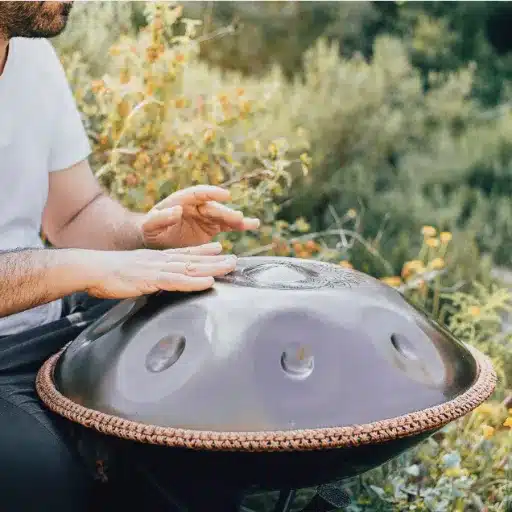
Handpan scales can be thought of as notes, or sound layers, that together create specific types of emotions or feelings, and set what can be thought of as a unique mood to music. All of the existing scales offer slightly different types of feelings connected to them, or emotions they evoke, and accompany a specific scale. Associated feelings can be but are not limited to to D minor scale, for example, Celtic Minor and Integral, which themselves are associated with introspection and joy. Combining the handpan and the mood, thus different handpan scales are created for different moods, forming a powerful and coherent partnership. It enables the musician to easily communicate large amounts of emotional baggage or feelings.
What is a Handpan Scale?
Playing the handpan involves understanding the notes arranged in a particular scale. Different handpans are designed in such a manner to give birth to exotic scales handpan, where each scale gives different emotions and feelings. The loop of notes put on the instrument allows the musician to creatively explore melodic ideas without much effort or thinking. These easy-to-play and friendly scales are sometimes modal scales from other parts of the world, like Dorian or Minor, or Major scales. It is the choice of scale which changes the energy of the whole song, whether it is lull or feel good or depressing, or happy, etc., thus allowing performers to fulfill their intellect in its vividness. Several of these rare handpan tunes also help the player in matching the instrument and creating mesmerizing musical symphonies.
The Importance of Scales in Handpan Music
Musical scales in handpan provide the foundation on which composing, singing, and making music are possible. In this respect, musicians use these scales as both a mode of constraint in their creative endeavors and go beyond the constraints with creativity in both shared and individual elements of music as they engender new forms and ways of expression. Every single scale has a specific optimization that accomplishes an elegant harmony among the available notes, allowing one to play music that is emotionally satisfying and engaging to the listener with minimal effort. For instance, exotic scales handpan such as Celtic minor, have a strong, mysterious, and contemplative feel, and the Ionian scales’ centrifugal resonance is reminiscent of happiness and warmth. Studies on musical taste and emotions have shown that different factors, like scale structure, affect listening activities to a considerable extent, which is to say that scales are also intrusive in determining what the listener will go through.
When selecting a particular scale, it expands the scope of the instrument as well as its applicability; this is what enables the handpans to fit multiple genres, ranging from world music to ambient styles. This, in turn, when viewed from an acoustical and resonance perspective, gives the followers in sound synthesis all they need for making rather active and engaging sound environments. These scales encourage players to go beyond techniques and rather express deep feelings and narratives through their play.
Exploring the Dorian Scale
The Dorian mode is another versatile and significant scale typical of many genres like jazz, folk, or blues. If one is to play the second mode of a major scale, they can call it Dorian since Dorian quality also features a minor scale, but with a natural 6th, which adds a specific and balanced sorrowful but happyish color; the construction of the scale is as a minor scale but with a sharpened 6^. The pattern of the scale is defined as minor with a raised 6th, and the pattern involves, tonic whole step, a half step, a whole step, a whole step, a whole step, a half step, and another whole step.
The majority of musicians prefer the Dorian scale due to its being conducive to inventive improvisation, and as it can be easily integrated into any genre. Take, for instance, in jazz, the sixth degree, due to its raised position, creates more liquid sound lines, while in folklore, the pitch of the scale provides a perfect source for remembrance of good stories. In addition, understanding how it sits within the span of fifth and fourth notes helps musicians turn modally in a way that creates a new edge in writing. The scale features how to play these complex chords with no effort, and those who complete it learn how to compose more emotive music.
Popular Handpan Scales
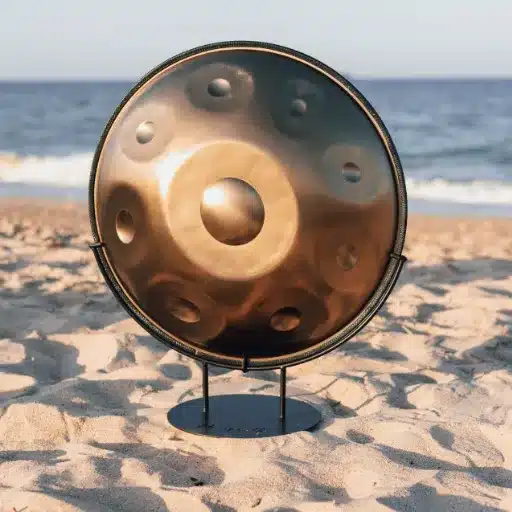
D Dorian (Aeolian)
This is a common handpan scale, quite gentle, almost meditative, and peaceful, giving a warm sound. It is perfect for beginners and pairs well with numerous genres, for instance, jazz and new age.
Hijaz
The Hijaz scale provides a unique character common in various compositions and offers a striking expression, especially concerning the Eastern motives, detailing specific stories through music.
Kurd
Another gentle scale, easy to master, and in the right hands, the music can come across as soothing and thoughtful.
Integral
Well melodically and emotionally designed, the scale allows one to connect and understand the music on a deeper level. Upon mastery, it sets the mood in an inspiring way, bringing in appreciable tones.
Pygmy
The Pygmy scale, with its enchanting, deep tribal concord, enables composers to create true tribal harmonics, which can soothe the listener, and this music is usually utilised in a trance or spiritual healing setting.
Note: The scales are good for both starting out and for more experienced players, since they can play with a lot of variety.
Overview of Common Handpan Scales
Particular emotions or moods are alright to make, and they reflect the tuning of each handpan scale; hence, every scale is different, formed to serve specific musical purposes and artistic endeavours. These are some of the more famous handpan scales in detail:
Dorian Scale
Every keen handpan can play perfectly on a Dorian scale since it is one of the most interesting scales, to say the least. For minor scales, the sixth degree is levelled up, giving a very soft and sad touch – tension and release are present – there is a nice action. The composition of this emotional appeal makes it absolutely suitable for pieces people like listening to, improvisations, and complex compositions of dynamic tunes.
Integral Scale
This scale provides a soothing and peaceful sound, and in this sense, it is in demand by musicians who target ambient compositions. As a rule, the Integral scale includes the notes placed in a way that allows convenient playing of the pentatonic scale and its atmospheric timbres. It is commonly used as a sound therapy, relaxation practice, and meditation.
Celtic Minor Scale
The Celtic Minor scale can be used when a nostalgic and rather mythical atmosphere is required for a musical performance. It sounds dwells within folklore because it points towards nature and ancestors. In this manner, its use in handpan music helps in attaining the delicate emotions.
Hijaz Scale
Among the many exotic scales played on the handpan, the Hijaz scale holds a special position. Such rare handpan tunes the hijaz used prominently with its counterpart segments embedded, lifts the mood, and enhances the scenes traced back to the Arabian Nights.
Akebono Scale
Akebono scale traces its origins to the soothing, tranquil sounds of Japanese music. It creates a very relaxed ambiance and is commonly played in meditative forms of music. This scale, however, makes things quite easy as most people, including beginners and even advanced artists, lean towards this scale since it comes so naturally and freely on rare handpan tunes.
Pygmy Scale
There are many exotic scales handpan players tend to explore, such as the pygmy scale. The sound that it creates is grounded, yet flowing, owing to its pentatonic nature, and its recognition in improvisations is high. Such a practical beauty made the base in African sounds so primitive, reflecting the essence of how it touched the spirit of humanity.
Harmonic Minor Scale
To make the music more energetic, a Harmonic Minor scale is used a lot in handpans. These include some serious intervals which bring on drama and relief inside at the same time; hence, it makes sense to avail these intervals for passionate and personal musical writings. This scale is especially appreciated for presenting dramatic pieces.
Characteristics of the Major Scale
The major scale is one of the most widely known scales in Western classical music, as well as in contemporary music theory. It is referred to as being happy and stable in modern music, as it consists of seven different notes connected by a pattern of musical intervals known as whole and half steps (W-W-H-W-W-W-H). The major scale can be heard in all music styles, as the notes follow a melodic pattern.
Another quality of the major scale, apart from the one I mentioned earlier, is the way it is happy according to the music it is configured in, which is the least. The resolution one experiences at the end of the progression to the start of such a progression, let’s say the happiness obtained by the one from the end, is universal to the happy genre of music. That is why it is repeatedly utilized to convey happiness. To mention, many universally appealing and loved pieces in popular and classical Western compositions are performed in major keys. Thus, to a certain extent, I may argue that Italy is in a class of its own.
Another striking feature of the Major scale is generally acknowledged to be its role in the evolution of harmony, as it is used in the establishment of major and diatonic chords. In addition to that, due to its unique layout, it is relatively easy to change keys without destroying the overall musical structure, which makes it easier to switch between musically related tonalities. For beginners, it is even easier to practice on the Major scale at all levels.
In a more specific manner, one can easily locate the notes of the Major scale on various kinds of instruments, especially the piano and other stringed instruments, where repeating the whole and half sections comes naturally. The listed, as well as a few more such points, are a testament to the sustained value of the major scale in music training and music creation processes.
Exploring the Minor Scale
When comparing the Major scale and the Minor scale, it should be noted that the Major scale is more associated with sweet and bright sounds, whereas the Minor scale is more identified by the sorrowful, muted sound, which is more cherished by artists in the modern and classical eras. The unique theme the Minor scale is set up on allows for the effective use of a flat third, flat sixth, and flat seventh. The Minor scale is known to have a muted aspect to it due to its use of a flat third, flat sixth, and flat seventh, which are not present in the Major scale.
Each of the major, natural, harmonic, and melodic minor scales carries its own notable features. In the harmonic minor scale, a markedly unique feature is its ability to bring out a different colour through the raising of the seventh note. This seventh is especially used to brighten the musical expressions of a particular section. The natural and melodic minor scales, on the other hand, follow a distinct course of their own. The natural minor scale upholds a smooth progression of the notes. On the other hand, the melodic minor scale, particularly in its rise, traverses the bright and dark parts of both major and minor scales, and hence, this scale is useful in both melodic and harmonic progressions.
Simple village music, complex jazz, rock, and cinematic music all have roots in the minor scale. This scale, although maturing in its potential, stays hidden from the limelight. Artists generally do not find it appealing, partially because of incomplete instruction. There should be a more active approach by composers, keeping its adventurous approach in mind. Any form of music that has the scale incorporated can smoothly introduce and address some of its melodic issues in the structure.
The Dorian Scale in Depth

D Dorian Notes: The D Dorian mode consists of the following notes: D, E, F, G, A, B, and C. Compared to the natural minor scale, the brightness of the Dorian scale is most notably achieved through its raised sixth note. In the Dorian mode of D, the scale is simply composed of D, E, F, G, A, B, and C. Since the Dorian mode has a little more melodic optimism, it has a different identity than other scales do.
The Dorian scale is often utilized in passages that combine emotive and rhythmically engaging elements. It is particularly adept at mode diatonics and in the minor harmony context, singing with chord progressions. The melodies are also enhanced with movement and depth, and the work retains its energy through the addition of the Dorian mode.
History and Origins of the Dorian Scale
The Dorian scale was one of the seven oldest modes that Greek music theorists had discovered by the time of classical antiquity. Its take on the natural minor scales, which have a raised sixth degree, enables it to function in both a complex and straightforward fashion. It is deeply melancholic yet uplifting at the same time, and mankind has remained captivated by it for so many years. The Dorian scale was named after the region in ancient Greece for its Soothing and Melancholic music, allowing a culture to have power and a sense of nobility.
It wasn’t until the Middle Ages and the Renaissance that the Dorian scale was deeply integrated into music theory and adopted as one of the church modes destined for sacred as well as secular compositions. The slowly-brightening but balanced quality of the Dorian scale made it great for the motets and filigrees of the period. Even beyond Europe, the scale continued to make an impression on smaller regions in the intervening parts of the cultures and their rich traditions, reshaping music in ways that are still known today.
Personally, I find the Dorian scale amazing for its adaptability and emotional content. The scale offers a distinct tonal range, which helps me connect to elements of the ancient world and the modern world using a blend of minor and major sounds. Be it in jazz improvisation, modern film scores, or traditional folk, the Dorian scale encourages and inspires my musical expression. Its relevance is truly transformative.
Musical Applications of the Dorian Scale
Created centuries ago, the Dorian scale has had a tremendous influence on music composition and ad-libbing in all genres of music because of the perfect pitch and harmonious blend of the major and minor modes. Some instances that prove the versatility of the Dorian scale include:
- Jazz Improvisation
The Dorian scale is a frequently used mode in jazz as it is a great fit in jazz compositions and a great tool in jazz soloing over minor seventh chords. The adaptable tonality of the mode makes it possible for solos to have a melancholy feel as well as a brightness through the melody. One admirable instance can be seen in the song “So What” by Miles Davis. - Folk Music Traditions
In the Celtic and British parts of the world, a great number of traditional folk songs and tunes are in the Dorian scale. Dorian folk songs have an ancient, blown feel, and certain excellent folk songs have a feel to the English in the Celtic parts that is extremely easier to see. For example, “Scarborough Fair” shows how the scale helps in tunes and tales. - Film and TV Scoring
In the film and television scoring world, the Dorian scale is usually employed to bring mystery, contemplation, or reflection, and certain dictionary feelings. The Dorian scale is a good choice to score films: it works well with deep and emotional universal feelings. - Pop and Rock Music
In the present day, the Dorian scale is found in pop and rock music, and this allows its feel to be integrated and adds novelty to the melodies. In addition, songs like “Oye Como Va” by Santana have been noted to have the Dorian scale, and have the flow in this choice and making it more appealing. - Classical Compositions
In classical music, the Dorian mode is not commonly used, but the mode resurfaces to enhance the intended effect in the playlist, and effectively to evoke times of the medieval periods as well as the Renaissance. This is the reason why the mode is used in the songs and is a good wooden addition to hymns or to close the symphony as an effect to enhance the texture of the piece.
Through creatively applying the Dorian scale in the various contexts listed above, it broadens their understanding artistically, encourages critical thinking, and builds valuable musical creativity.
Why Choose the Dorian Scale?
The attractiveness of the Dorian scale is the fact that it sits in the middle of so many things, offering something easy to understand for people in every field. As opposed to other widely used scales, such as the major and minor scales, the Dorian scale is different and offers a brightness and melancholy, via the raised sixth note, that is known for its balance. There is also the fact that the Dorian scale is so appealing to use as different scales of well-known musical styles, all thanks to its different applications as a tool, like for jazz improvisation, folk, and even modern musical styles.
The Dorian scale is abundant with a unique and mindful creativity that increases the potential development of melodies and chord progressions on the scale, harmonically. The Dorian Scale, unlike the other scales in the world, enables easy experimentation for harmony and also allows harmony with the other scales, and as such, provides more room for modal harmony. Along with the above facts, the scale allows novices and notable professionals to take advantage of its applicability to routines and live performances. This is because the scale presents a basic pattern that anyone can follow without necessarily having to put in an effort. If you need to get forgotten emotions, employ innovative strategies towards the music, or even re-establish your music understanding, the Dorian scale offers a unique and deeply knowledgeable outlook.
Kurd Scale and Other Unique Scales
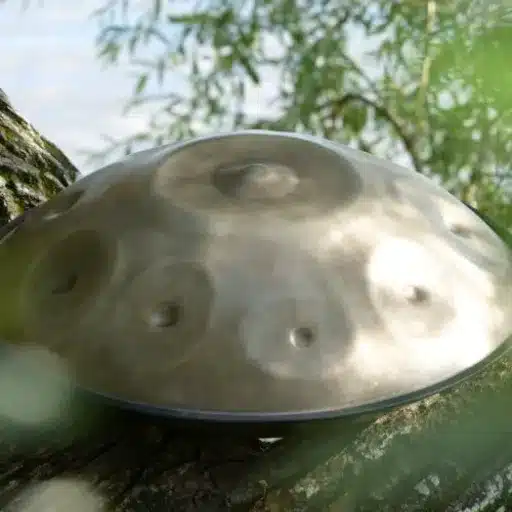
The Kurd scale is one of the most distinctive and stirring of all the musical scales. It evokes the spirit of the Middle Eastern culture along with other types of folk music. It is unique due to its ability to invoke deep feelings of melancholy. This mode of the Kurdish scale is used extensively in modern and traditional music.
Other types of musical scales, such as the Phrygian and Lydian, also share this need for the special sound they produce. The Phrygian scale is known for its exotic taste and prominent dominance, while the Lydian mode, on the other hand, is enjoyable and commonly used in film scores. As a musician works on the use of these scales, he is progressively pushed into diversifying his melodic lines as a range of expressive features open up to him.
Understanding the Kurd Scale
Called the Kurd scale, it is a remarkable musical pattern that is often used in the traditional music of the Middle East, but in reality, it is a scale that can be applied to many kinds of Eastern and Western music and beyond. Even though it has some features in common with the harmonic minor in music, the Kurd scale distinguishes itself further by its specific intervals that are peculiar and depict sadness amidst texture. It incorporates both Minor and Phrygian elements, creating a special atmosphere able to express feelings of despair and hope.
This scale is also loved not only by the folks from this geography but also by the modern people of the earth dummies who delve into exotic scales and handpan. Its flexible nature enables the exploitation of blending in different genres, including film scores and practices such as improvisation. One good example is that musicians could leverage the potential of the nuances in the Kurd scale to add emotional potency to their tunes.
Furthermore, the scale’s adaptability across instruments—be it string, wind, or electronic—makes it a valuable tool for composers and performers. The balance between its minor tonalities and bright, ornamented phrasing provides a platform for distinctive musical storytelling.
Comparing the Kurd Scale to the Dorian Scale
| Aspect | Kurd Scale | Dorian Scale |
|---|---|---|
| Character | More melancholic and dramatic | Balanced minor with raised sixth |
| Emotional Range | Deep feelings of despair and hope | Tension and release, soft sadness |
| Best Use | Serious compositions, embellishments | Jazz, folk, rock improvisation |
| Cultural Origin | Middle Eastern tradition | Ancient Greek modes |
Between the Kurd scale and the Dorian, I discern noticeable differences in two: the character of each scale and how they are applied. Due to the given set of intervals, the Kurd scale tends to sound more melancholic and even dramatic, as its character is primarily among the more minor scales with some exotic scales and handpan elements. Such a scale is best suited for conveying a mood or making a piece of music sound pseudo-philosophical. However, if the Dorian scale is examined, the raised sixth scale degree does not project as much darkness, though the basis of the scale is still minor. Such a symmetrical distinctiveness enhances the versatility of the Dorian mode, making it frequently used in jazz, folk, and rock music for its seamless incorporation of both ‘dark’ minor vibes and ‘bright’ major tones.
Sound-wise, both the scales entice a player to find new soundscapes where improvisation would be a great skill; however, both these exotic scales handpan serve different functions narratively. The kurd scale I would personally choose for more serious musical compositions, incorporating a lot of embellishments and dense, sinuous, long phrases. Likewise, one may notice how balanced and flexible the Dorian scale is suitable for playing intense improvised solos with ease, or even more, providing catchy mixed with energetic patterns. Whereas the kurd scale predisposes composing music filled with more despair, as well as suffice it to say music that helps foster concentration, the dorian scale predisposes to music filled with more energy and built around rhythm, even loud, hyped rhythm. Therefore, each sense is very clear, all these rare handpan tunes differ very much in every star minute and more importantly allow me to understand which one would be suitable for my music depending on the particular emotions and style required.
Exploring Other Rare Handpan Tunes
Some examples of scales that offer unique music and are not found on most other instruments are the Hijaz, the Pygmy, and the Celtic. The Hijaz scale, having its roots in Middle Eastern music, is deeply mystical and exotic and features the semitone intervals alongside a vivid harmonic progression. The Pygmy musical scale is pretty different and has a soft and bass-rich sound, which is useful for creating an introspective, meditative track. Pygmy scales are known for their calming and meditative effects. The Hijaz and Pygmy scales are both considered alternative music, while the Celtic scale is a folk music scale that is popular for its energetic and bright notes. Such scales open wider possibilities in musicians’ compositions as they aid in harmonious historical and cultural sounds, enabling music to have a deeper and richer meaning.
Finding the Right Scale for Your Music
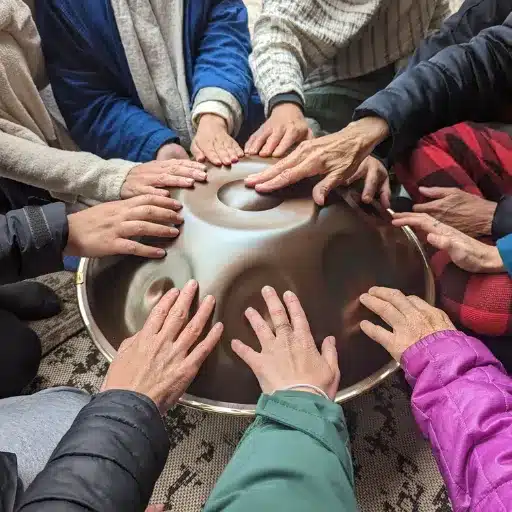
Picking the right scale is important for the kind of tone and narrative you hope to achieve. For a calming ambience, the Pygmy scale is best because it helps with the introspection aspects through its soothing notes. To aim for something that is in the Middle Eastern domain, you can utilize the Hijaz scale, and for something bright and uplifting, the Celtic scale would be best. Emphasize their historical and emotional ties with the regions the scales come from, and associate the music and score with the point-to-point feelings that you wish to achieve.
Considerations for Choosing a Handpan Scale
While making a pick of a handpan scale, it would be best to look into what you want to play and how you want the composition to feel. For example, the scale used by the composer will certainly dictate the emotional content intended. Major handpan scales like Kurd and integral tend to enhance the feelings of happiness and hope, hence ideal for cheerful and complementary songs. However, when using minor exotic scales on handpan, such as Celtic minor and Hijaz, the scales tend to sound deeper, passionate, and even sometimes melancholic, thus suitable for more relaxed and storytelling musical compositions.
Another factor is the number of musical notes per handpan and their distribution among the segments. Exotic scales, for example, mostly use the pentatonic scale, which requires fewer notes because beginners work with a set of minimal rules and sound exploration for meditation. However, complex musical resonances and detailed music playing, where a musician builds various combinations of notes other than scales, are common in other scales, such as the diatonic or chromatic scales.
The focus on the use of a particular scale is often determined by the musical cultural boundaries because scales are ethnic in nature. The exotic scales handpan, for instance, will mainly be positioned in the Middle East since that is where the natures of the Middle Eastern scales are found. For this reason, many musicians will be able to improve their performances by adopting these elements over those rare handpan tunes.
Lastly, usability and harmony with other instruments are practical considerations that should always be remembered. More ‘consonant’ scales make a better accompaniment than more ‘dissonant’ ones. This helps in overcoming the problem during any group or band practice or performance. In doing so, they effectively choose the scale well-suited to both their artistry and skills for fulfilling handpan playing.
Experimenting with Different Scales
Playing a handpan, I discovered that I can easily learn many exotic scales, most of them with pentatonic notes and repeated material. Therefore, I passed on the learning of the more exotic scales that the handpan usually comes with, necessitating the use of more percussion than melody to achieve the same musical purpose. Receiving one scale, then the next, made it clear that the practice was deliberate. More importantly, the change of scales and spacers dramatically affected my music, and the instrument became more intimate.
Aside from the scales, it was also of concern how they worked with the performance and the musical expressions. Each scale, for example, had its geometric shape because some keys came easiest and fastest to me. Other commands also challenged my abilities and changed certain techniques that I already acquired. This is how I found sets of notes that were most ready to play and selected which patterns I wanted to use in my performance.
Furthermore, I incorporated working with others into the experimental process as well. Playing a piece in different scales with other musicians showed the degree to which certain tones and ranges of notes worked. One such experience was a satisfaction one took in using the pentatonic scale in the ensemble since it solved the inherent tonal problem of harmonizing in such scales, and engaging with others became more fun. Playing around with those different scales and exploring each came to help me understand better what scales would enhance the technical as well as the emotive expressiveness in my music.
How to Create Unique Melodies with Scales
Composing new tunes requires learning about how to fully utilize the available musical scales and what emotion each of them can create. Building something new requires exploration using the existing scales known to man, but in a more innovative combination. As an example, when switching from a six-note major to its parallel minor, a rather dramatic change in the colour of sound is possible. Likewise, the exploration of modes, such as Dorian or the bluesy Mixolydian, due to their structure of the steps, provides a different color or Prick to the compositions.
One more approach is the use of exotic scales, like the whole tone scale or the diminished scale, in order to enhance some otherworldly or tension-creating feeling in the piece. In case one wants to go one step further, one may cross African five-note or contemporary twelve-note systems with existing molds. If you want to make notes choice specific, you can use either certain handpan tuners or use the modern music technology that is available in electronic form for the dissection of the note relationships.
The recent statistics indicate that the localization of the rhythm in scales is a technique that is used by quite a number of composers in an effort to produce new and creative works. Case in point, infusing syncopation or changing current rhythms within the applied tessitura may enable one to have a static per meaning yet interesting melody. It is important to consider the emotion carried in the melody-using octaves or, for example, shifts, perhaps step or non-step in the melody, which works wonders as the emotional response to the music changes appreciably.
After all, there can be no limit to creation when one is with theory, a little bit of creativity, and quite a bit of practice – no two melodies will ever be boring, and every melody will be special within its context.
Reference Sources
- The Sound Artist
Traits of a Great Handpan: Quality Factors
This source discusses exotic scales and their unique, ethnic sounds, providing insights into the appeal of such handpans. - Pures Music
Handpans Available for Sale in Multiple Popular Scales
This site offers information on professional handpans, their value, and their appeal to serious musicians. - Hluru
Choosing the Right Handpan Scale: A Comprehensive Guide for Beginners
This guide provides detailed information on matching handpan scales to different musical styles and needs. - Handpan Shop Europe
Should I Buy a Tongue Drum, a RAV-Vast, or a Handpan?
This source discusses the growing popularity of handpans and their diverse audience. - Intemenos
The World of Handpan Music on YouTube: 10 Popular Musicians
The article discusses different areas of usage of handpans for meditation, sound healing, and musical purposes – enhancing their multifunctionality.
Frequently Asked Questions (FAQs)
Q: What are the popular handpan scales to explore?
A: When it comes to exotic scales in handpan music, the Dorian mode, the natural minor mode, and the harmonic minor mode are the scaling modes that are most widely utilized. These scales allow variation in the artistic content of the musical works served by each one of them, allowing submission of each to a certain taste or mood. A Dorain scale can be syncopated in a buzzy way, whereas the other type, the harmonic minor scale, facilitates more, dare we say, rare handpan tunes. Some of the easy scales, such as the pentatonic scale, are preferred for starters, as learning how to play them as easily as possible, hence all these easing mechanisms. If you are already confident with those, you might want to try the pygmy or hijaz scales, which contain both some ethnic instruments and some sophisticated but catchy melody lines.
Q: How can I understand handpan scales better?
A: Every musical scale contains various notes organised in a certain sequence. The manipulation of the handpan scales helps to grasp the necessary notes of each scale. Each music scale has a peculiarity in sound coloration; for instance, in the Dorian scale, the second degree of the scale is a minor third; however, it is the sixth degree of the scale that is heightened, which gives a particular feel to that regime. In contrast, the major scale can be difficult to erase from memory because of the bright tonal compass. With music theory, such an order of notes as in handpan playing can also be explained and played easily. In addition to that, to enhance understanding of certain ‘hard’ pieces of music, it is beneficial to understand how that scale is being applied by different players, e.g., musicians. In addition, such understanding of these scales is further enhanced with the use of handpan teachers or even by attending a class on the instrument.
Q: What is the significance of the minor scale on handpans?
A: Minor scale lingers longer in the notes of the handpan because it involves quite a lot of internal thought than any other scale. The basic minor scale and often the Aeolian can represent a sad, lonely mood, too. This is the scale that handpan musicians use when they want to include emotion in their songs. Although when the harmonic minor is played, it brings an Arabian or Persian mood. When it comes to playing with exotic scales handpan, minor scales offer magic in plenty, enjoy.
Q: What are some common handpan scales for beginners?
A: As a beginner, examples of simple scales that are immediately accessible include the C major and Dorian pentatonic scale. These are user-friendly since they do not require many complex techniques in order to play them. The C major scale is diatonic; thus, the topography of the notes is quite simple and memorable. Dorian pentatonic, on the other hand, is unique and interesting but equally easy in terms of playability. Once their self-esteem grows, more scales can be explored like for example, Harp, Hexatonic, B Minor, and B Hindustani. Diverse but specific. Above all, it should be remembered that it is the anatomic handpan that facilitates the particular musical development of the player.
Q: How do I choose the right scale on a handpan?
A: Every single emotion would have an appropriate scale in a handpan. For example, the harmonic minor is sad, and the natural minor is suntan. A note placed at the bottom of the pitch range is quite significant, especially when considering the sound and character of the handpan. There is a likelihood that a majority or several individuals would consider trying such simple scales first over Hijaz or Akebono exotic scales handpan. The truth is, there is no good or bad scale; it’s the one that conveys the mood and objective that you strive for.
Q: What is the world of handpan scales like?
A: The handpan scale area is very extensive, comprising many different scales that can be played by beginners as well as professional handpan players. It typically moves from, for instance, the well-known C major scale to other less-known, this rather exotic external Celtic and Pygmy scales, that are self-contained, giving out order through their uniqueness. The approach to scales is already in harmonic and melodic ones, which help paint the music in different ways. The main advantage of handpan instruments is the ability to take music from any tradition, such as Arabic maqams and Western music. The beauty of the handpan scales is that they allow one to use tough and rough measures and provide the base for building one’s expressive musical thoughts, which is a very rich and broad scale of study.


